Tuesday, November 5, 2013

Ruthenium

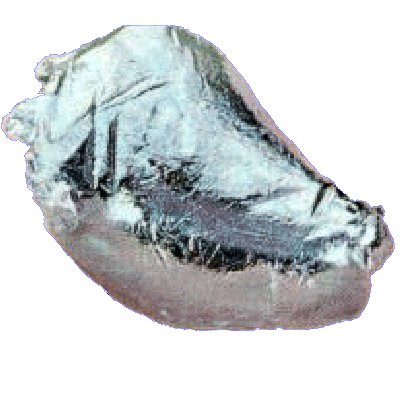
Discovered in 1844 by Karl Klaus of Russia, ruthenium often occurs with members of the platinum group of metal. It is a silver-gray metal and is VERY brittle, and is often found in the Ural mountains in North and South America. While it is often found in other metals and elements, there is a complex process that can be used to separate it.


Ruthenium is used as a hardener and is one of the best for addition to palladium and platinum. It is often alloyed with them to make electrical contacts with ultra wear resistance. It does not often tarnish at room temp, but will oxidize in air 800 degrees celsius.

Ruthenium was named after the Russian word "ruthenia", which means "Russia". It makes sense, being it's first discoverer was from Russia. It is possible that a Polish chemist discovered ruthenium first, but his work was never backed up and he withdrew his claims, making Klaus the founder.

Friday, November 1, 2013

Technetium

What is technetium?
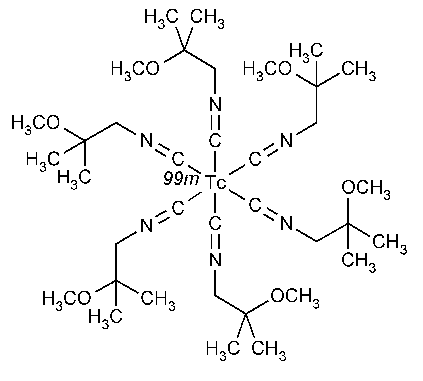
Discovered by Carlo Perrier and Emilio Serge of Italy in 1937, the first traces of technetium were found in a sample of molybdenum that had been bombarded with neutrons.

 Technetium is a bright, silvery white metal that tarnishes slowly in moist air. Techentium's cellular structure is very similar to that of rhenium. Technetium is a corrosion inhibitor for steel and is also a superconductor at 11K and below.

The word 'technetium' derives from the Greek word 'technikos' which means an art of technetos: artificial, this was the first element made artificially.
Cellular structure of technetium


Medical isotopes tests have technetium in them.

Monday, October 28, 2013

Molybdenum

Discovered by Carl Wilhelm Scheele of Sweden in 1778, molybdenum is one of the most COMPLICATED elements to pronounce (at least for me). The word comes from the German word molybdenum, which means 'lead'. As for pronunciation, it is pronounced 'mah-lib-deh-num'. It is a pretty, silver-white metal that is relatively hard.

Molybdenum sulfide
Molybdenum is a very important alloying agent  that contributes to the toughness of quenched and tempered steel. It also improves the normally low strength of steel at high temperatures. Molybdenum forms salts with valencies of 3, 4, or 6, but the hexavalent salts are the most stable. It's sulfides are used as a lubricant, especially when there are high temperatures where oils would normally decompose.


Tuesday, October 22, 2013

Niobium

What is niobium?
Blue and silver niobium, side by side
Discovered by Charles Hatchet of England in 1801, niobium is a platinum white metal with a metallic shine to it. It is named for a character in Greek mythology, Niobe. She is the daughter of Tantalus. It was named after her because niobium is often associated with tantalum.

Niobium has also been called Columbium, since it was first discovered in Columbia, America. Though niobium is it's official name, it is still called Columbium by many people.

Niobium is a white metal, as I mentioned above, but its outer layer turns blue when exposed to room temperature air for too long. It is very ductile, malleable, and highly resistant to corrosion. It doesn't occur free in nature, and (as mentioned above) is almost always found with tantalum.
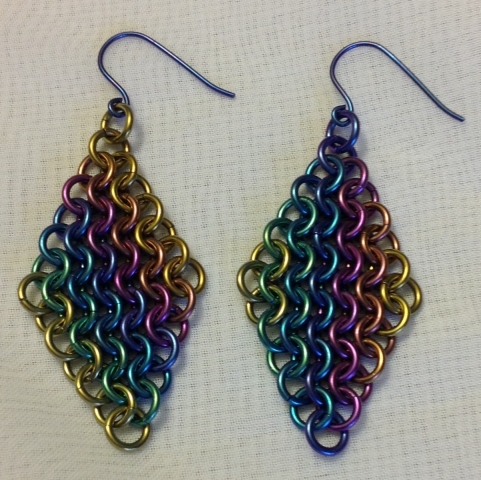
Some cool niobium earrings


Niobium, much like tantalum, can act as an electrolytic valve allowing alternating current to pass in only one direction through an electrolytic cell. It is used for advanced air frame systems, and also in lamp filaments and jewelry... for jewelry, it can be colored using an electrolytic process.


Thursday, October 17, 2013

Zirconium

What is zirconium?
Zircon
Discovered in 1789 by Martin Klaproth of Germany, zirconium was named for the mineral zircon. It is also thought to be named for the Persian word 'zargun', meaning gold-like,  describing the color of the gemstones known as zircon, jargon, hyacinth, jacinth, or ligure.


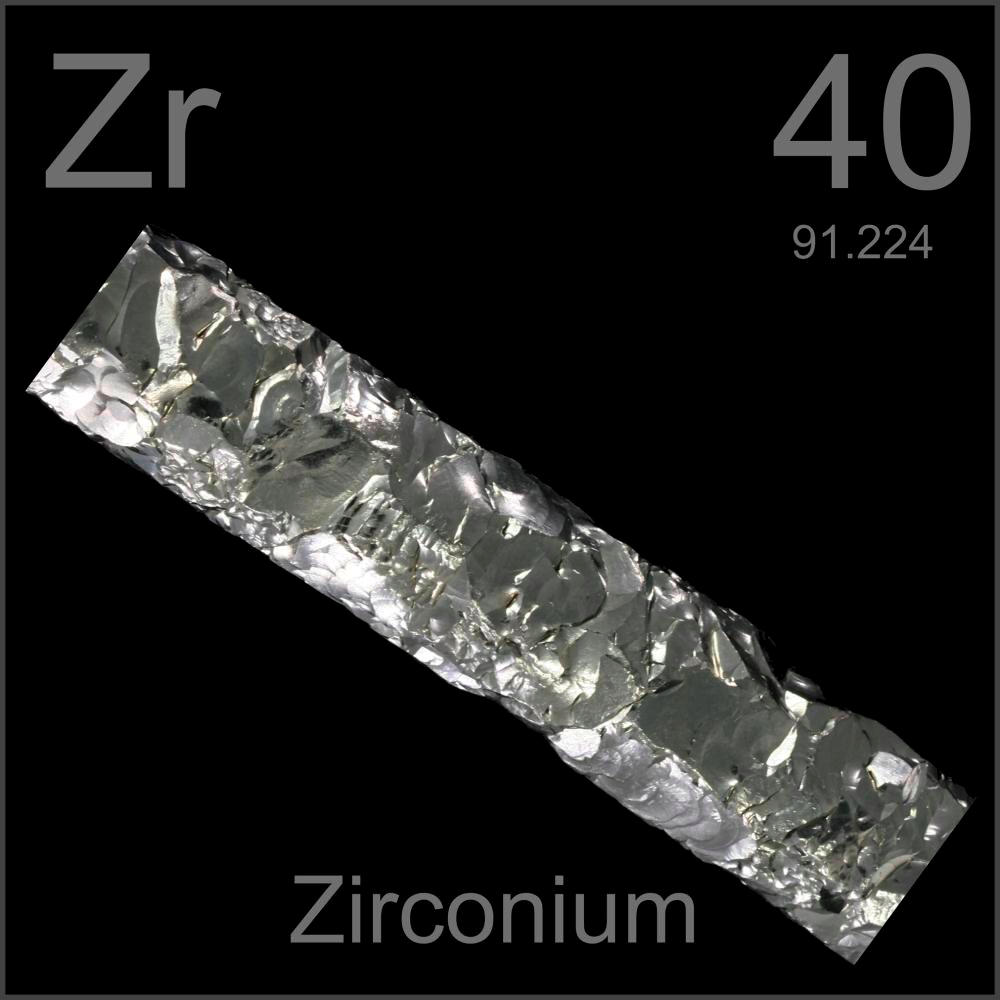
Zirconium, however, looks very different from the gemstone. It is a grayish white metal, the polar opposite of the sunny gemstone shown to the right. If finely divided, zirconium can ignite on its own accord in the open air. The solid metal is usually quite stable though.


Zircaloy, a component that can be gotten from zirconium, is an important alloy for nuclear applications. Zirconium also has a low absorption cross section for neutrons, therefore making it very useful for nuclear energy applications, like cladding fuel elements.

Some more items zirconium is used for:


  • Acids (it is resistant to corrosion in seawater)
  • Alloying agent in steel
  • Getter in vacuum tubes
  • Component in:
    Surgical appliances
    Photoflash bulbs
    Explosive primers
    Rayon spinnerette

Wednesday, October 16, 2013

Yttrium

What is yttrium?
Discovered in 1794 by Johann Gadolin of Finland, yttrium got its strange name from the small village of Ytterby, near Vauxholm, Sweden. Ytterby is the village which has the quarry where  the minerals erbium, terbium, and ytterbium are mined, hence the name "yttrium". Yttrium is pronounced "it-tree-um".

Yttrium is a metal with a silver luster to it. It is usually very stable in open air, except when it is very finely divided. Yttrium turnings will ignite in open air if their temperature is anything over 400 degrees celsius.


Iron yttrium garnet


Yttrium is a component of the phosphors used to produce the red color in tv picture tubes. The oxides in it can be used in ceramics and glass, as yttrium oxides have high melting points and impart shock resistance and low expansion to glass.

* Yttrium garnets have a hardness of 8.5 on the Mohs scale, and are often used to simulate diamonds.