Wednesday, June 19, 2013

Peruvian Blue Opal

What is a peruvian opal?
Rough peruvian opal
A peruvian opal is a very rare and gorgeous stone. It is a translucent blue stone, and depending on what minerals surrounded it during it's forming, it can be clear, showing throughout the stone many different shades of blue, or a rougher stone that has black streaks running through it.

Peruvian opals are very highly priced, and unfortunately, many dyed stones are being sold by unfair dealers at high prices, making the poor buyer think they are getting blue opal when all they are really getting is colored pebbles. The dyed stones are very common and sell for great prices at gem shows and internet auctions.

Where is it found?
The peruvian opal is found, well, in Peru, hence it's name. These gems can only be found in mines in the Andes mountains, and this is what makes them so rare. Many gems can be found in multiple parts of the world. Peruvian opals are ONLY found in Peru unless they are sold in jewelry stores etc.

The Mystic peruvian opal

The blue opal is said to have "relaxing energies". Legend says that it takes tension away from the mind and body and lets creative ideas come more naturally. It is also said to be good for quieting down the mind and is a help when you need to fall asleep. These are probably true... but more so because of the opal's soft color.


Tuesday, June 11, 2013

Iron

What is iron?
Chunk of 99.97% pure iron.Iron is the 26th element in the periodic table of elements. Iron is a very old element, as it has been known to man since prehistoric time. Pure iron is highly reactive to chemicals and corrodes rapidly, especially in thick, moist air and at elevated temperatures. 4 different forms of iron are known, a, b, g, and d. The a form is very magnetic, but when it is transformed into the b form, the magnetism disappears.


What is it used for?
Iron actually has many different uses. It is vital to plant and animal life. However, though it is relatively vital in humans, it appears as a molecule. Iron metal, because of it's properties, is often mixed with other metals and carbon for commercial uses. These metal concoctions are called Pig Iron. Pig Iron is very different from regular iron, as it is more brittle and harder. It is also easier to mix into other irons and also steel.

Wrought Iron
Wrought iron is another type of iron that contains only a few tenths of a percent of carbon making it malleable, tougher and less fusible than pig iron. However, wrought iron is usually more grainy and fibrous than regular iron.

Where is it found?
Iron is a very abundant metal that is found in many places, including:

  • The sun
  • The stars
  • Meteorites (siderites)
  • The Earth's core (mainly made up out of iron)
  • Taconite
  • Magnetite
  • Black sands
  • Stream banks


Friday, June 7, 2013

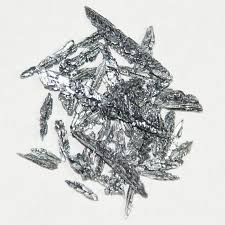
Manganese

What is Manganese?
Manganese, or mn, is the 25th element in the periodic table of elements. It was discovered by Johann Gahn, of Sweden, in 1774. Manganese's name comes from the Latin word for magnet, referring to the magnetic properties of Italian manganese, better known as corrupt manganese.

Regular manganese is a rather brittle grey metal. It is highly reactive to chemicals, and decomposes cold water. Manganese can only be magnetic after special treatment, hence calling it corrupt manganese.

The alpha form of this metal is very stable at room temperature, making a hard metal, but gamma metal at lower temperatures is very soft and could be cut with a knife.

Where is it found?
In 1774, Johann isolated manganese by reducing its dioxide with carbon. The metal may also be obtained by electrolysis or by reducing the oxide with sodium, magnesium, or aluminum. Manganese-containing minerals are widely distributed. Pyrolusite  and rhodochrosite are among the most common of these minerals.

What is it used for?
 Manganese is added to improve the strength, toughness, stiffness, hardness, wear resistance, and hardenability of steels. When mixed with aluminum and copper, manganese is very magnetic. This is the treatment used to create corrupt manganese. Manganese dioxide is used as a depolarizer in dry cells and as a decolorizing agent for glass that has been colored green due to iron and other stains.


Gaspeite

What is gaspeite?
gaspeite cabochonGaspeite is a very rare mineral that is only found in a few locations. It is a beautiful light green stone, and it has the color of a granny smith apple. It is the only stone known that has this unique color, and sometimes, depending on the minerals surrounding the stone when it was made, it can be neon green. These stones often contain brown patches, also due to minerals, which makes the stone even prettier.

Gaspeite is a very soft, easy to scratch and dent stone. It is only a 4/4.5 on the Mohs scale. It should be worn with care when in jewelry. Gaspeite is a relatively new stone also, only discovered in 1966 (HEY! That's my Dad's birth year!).

Where is it found?
Gaspeite is commonly found near nickel sulfide deposits. It was named after the place where it was first found and is STILL most commonly found, Gaspe Peninsula in Quebec, Canada. Though Canada is the main source of Gaspeite, it is also found in Western Australia.

The Mystic Gaspeite
Since gaspeite is considered a newer stone, there are not many stories about it, though it is said to bring good fortune. As for healing powers, it is said to reduce stress and help with heart, gall bladder and lung problems. Not that I believe any of that, but a little good fortune would be nice right about now....


Tuesday, June 4, 2013

Chromium

What is chromium?
Chromium is a lustrous steel-gray metal.Chromium is the 24th element in the periodic table. Discovered by Louis Vanquelin in 1797, chromium is a beautiful steel-gray metal that takes a high polish. It is a very hard metal, and therefore highly resistant to corrosion. Chromium has a very high melting point of 1857+/-20 degrees Celsius, a stable crystalline structure, and a moderate thermal expansion.

Chromium was named after the Greek word "chroma", meaning "color", due to the fact that chromium compounds are always very colorful. However, as pretty as the compounds can be, they are very dangerous because they are toxic.

Where is it found?
Chromium Compounds
The main ore of chromium is chromite. The chromium metal can be produced by reducing the chromite's oxide with aluminum. About two-fifths of the chromite ores and concentrates in the world are produced in South Africa, but Kazakhstan, India, Russia, and Turkey are also very big producers of the metal. Untapped chromite deposits are plentiful, but geographically concentrated in Kazakhstan and southern Africa.

What is it used for?
Chromium has many uses, including:

  • Hardening steel
  • Component of stainless steel
  • Plating that is shiny and resistant to corrosion
  • Catalyst
  • Addition to glass to produce an emerald green color
  • Important in pigments, mordants, and oxidizing agents.


Friday, May 31, 2013

Vanadium

What is vanadium?
Vanadium was originally discovered by the Mexican/Spanish mineralogist Andres Manuel del Río in 1801. He extracted the new element from a sample of lead ore and found salts formed a multitude of colors. His original name for this colorful element was panchromium, meaning all colors.
del Rio renamed his element 'erythronium' (Greek for 'red') because the crystals of vanadium would turn red upon heating.


Then, the French chemist Hippolyte Victor Collet-Descotils claimed del Río's element was actually chromium. del Río retracted his discovery claim. Finally, Swedish chemist Nils Sefström rediscovered the element in 1831 and named the element vanadium after the Scandinavian goddess of beauty Vanadis, putting an end to the disputes about who discovered the element.

But enough about the founders. Vanadium itself is actually a very interesting element. It is named after the Scandinavian goddess as mentioned above because as she was the goddess of beauty, the stones were very beautiful as they had multicolored compounds. However, pure vanadium is a soft, ductile bright white metal. Vanadium has good corrosion resistance to alkalis, sulfuric acid, hydrochloric acid, and saltwater, but it oxidizes readily at temperatures exceeding 660°C. The metal has good structural strength. Vanadium and all of its compounds are toxic and should be handled with great care.

What is it used for?
Vanadium is used for many things, such as in nuclear applications, for producing rust-resistant spring and high-speed tool steels, and as a carbide stabilizer in making steels. Just about 80% of the vanadium that is produced is used as a steel additive or ferrovanadium. Vanadium foil is used as a bonding agent for cladding steel with titanium. Vanadium pentoxide is used as a catalyst, as a mordant for dyeing and printing fabrics, in the manufacture of aniline black, and in the ceramics industry. Vanadium-gallium tape is used to produce superconducting magnets.

Where is it found?
Vanadium is found in the Earth's crust at 50 parts per million. It also occurs in approximately 65 minerals, including vanadinite, carnotite, patronite, and roscoelite. It is found in certain iron ores and phosphate rock and in some crude oils as organic complexes. Vanadium is found in small percentages in most meteorites, but not all. Vanadium metal also may be produced by calcium reduction of V2O5 in a pressure vessel.


.


Thursday, May 30, 2013

Titanium

What is titanium?
Titanium is the 22nd element in the periodic table of elements. First discovered in 1791 by William Gregor of England, it was named for the Latin titans, which, in mythology, are the first sons of Earth. The name is appropriate, as pure titanium is a beautiful white metal with low density and very high strength and high corrosion resistance.

 This being the case, it is resistant to most acids, gases, and chloride solutions. The only thing that harms titanium is when it is free of oxygen. Titanium burns in air and is the only known element that burns in nitrogen.

What is titanium used for?
Titanium is used for many things, including:

  • Prevention of cathodic corrosion
  • Surgery of the human body. Since it is already in the human body, it is one of the few safe metals to use during dangerous surgeries. It is non-toxic to the body, unlike some other elements.
  • Titanium DIOXIDE is used to make man-made gemstones. However, the gems are usually very soft and not very good.
  • Titanium dioxide is very bright white pigment, and is used to make high-quality wall and artist paint. It is also used in napkins and toothpaste.The paint is an excellent reflector of infrared radiation, and because of this, is often used in solar observatories. The paint is also permanent.
  • Because the metal burns in oxygen, titanium is often used to produce smoke screens.


Where is titanium found?
Titanium is the 9th most abundant element in the earth's crust. It is almost always found in igneous rocks. It occurs in rutile, ilmenite, sphene, and many other iron ores and titanates. Titanium is also found in coal, ash, plants, and even in the human body. Titanium is found in the sun and in meteorites. Rocks from the Apollo 17 mission to the moon contained up to 12.1% titanium, proving that the moon also has titanium. Rocks from earlier missions showed lower percentages of titanium.